- Jan's Journal
- Posts
- Jan's Updated Belated April Newsletter☺

Hello Friends! Thank you for subscribing! Enjoy some of my personal and writing updates, sneak peeks, and reviews. ♥

The Pretty Daffodil
— Jan Goldyn — |
A daffodil stood blooming
On an April morn
With raindrops still tricklin
From a late night storm

But the good sun shown and sparkled
On her yellow tresses fair
Not in all the meadow any lovelier was there.
She pushed her golden cup
Toward the heavens high
And waived in the wind
To all who passed her by

And though she knew her beauty,
With her perfume soon would fade
She smiled as one who’s chosen
To adorn earth’s first parade.

April Update
Beach Thoughts in Spring

If you’ve ever gone to the ocean, do you remember the first time you saw it?
I was around eight years old and our car came up over an arched bridge. “Watch for the ocean, watch for the ocean!” Mom announced. Then I saw it. The huge expanse of blue at the horizon.

The sight drew something from deep inside of me. A whole new part of my world — intimidating and thrilling all at once.

Even though the thrill is never as sharp as the first time, it’s still a splendid rush . My husband and I try to go to the shore each spring. I’m happy now to sit in a beach chair, mesmerized by the calming repetition of the waves.

In younger days, we loved to let the large waves carry us to shore. Our bodies no longer permit that☺ But sitting together, captivated by the white capped surf is its own joy.

Our kids joined my husband and I this year. As I watched little children run in and out of the tide, I thought of ours when they were small, timidly and excitedly letting the water rush in at them. They are now the brave body surfers

We watch egrets, seagulls and pelicans. It’s amazing how the pelicans fish — flying together in unison, each diving at just the right spot.

When it’s time to leave, I always tell the ocean goodbye. This time, one giant wave seemed to tell me “I’ll see you again next spring.”

Prequel, Julia
My vision for the unveiling of “Julia” had been Spring 2025. I’m now focusing on Summer 2026.My life has just become unexpectedly busy! But I promise to do my best and will update you well in advance!
**********************
I am so excited to be working on my Prequel — Julia. You’ve all given me such super feedback on Coal Town Girls! Those of you who have grown up locally have been sharing your excitement at seeing the landmarks of your youth (or your present!) showcased within its pages.
Now, with Julia, I’m taking a journey further back in time to the people, places, struggles, triumphs and dreams of those who came before Joan and Mary. I can’t wait for you to join me.
-Excerpt from Julia -

“He descended the steps from the upstairs rooms like a mausoleum piece enshrining the male form – a male form in deep brown pin-stripes.
A gold watch and chain arched from the second button of hiswaist coat to its pocket. He adjusted a tie of gold paisley which hugged his neck under a firm white collar.
His hair was carefully parted on the side and slicked back away from an edge of a five-o'clock-shadow.
Each step of his oxfords brought him closer to Julia with the casualness of a jungle cat perusing the evening skyline.”
Jan’s Reading Nook

Charlie Chaplin’s Own Story
— Charlie Chaplin —

When Albert Einstein met silent comedic film star Charlie Chaplin in 1931, he told him,
"What I most admire about your art is its universality. You do not say a word, yet the world understands you!"
Chaplin retorted,
"True. But your fame is even greater! The whole world admires you, even though they don't understand a word of what you say."
Charlie Chaplin’s Own Story was assembled by Chaplin’s oral narratives to Rose Wilder Lane. It is considered to be an elaboration of his true life story, Chaplin having later written his own autobiography published in 1964.
Still, the main themes of his life stay true to point. He grew up in poverty in South London, England, right around the turn of the 20th Century.

Both his parents, Hannah and Charlie, Sr., had been fairly successful stage people. They lived very well until his father became a more intense alcoholic than he had previously been and left the family. Charlie has few memories of him as he was very young during the “good days.”

Charlie’s mother, during the early days of her marriage to Charlie, Sr., had run away to South Africa with a con-man by whom she became pregnant with Charlie’s brother, Sidney. She resorted to or was forced into prostitution — this fact is not mentioned in the book. She then eventually returned to London and reunited with Charlie, Sr., with whom she would have their son, Charlie.

Charlie, one day when he was fairly young, was taken by a trickster in his “Wagon of boys” who were to become “stars of the stage.” After this man saw Charlie dancing in the street — which Charlie loved, having drawn many fans — The man lured him into his wagon.

Charlie’s life on the road with the other boys was anything but glamorous. They were essentially working twenty hours a day in music halls and basically starving.
By a stroke of luck, a good time later, his mother found Charlie in the street and took him home. “Neither my father or brother Sidney were there. Sidney had gone to sea.”

Mother undressed me with her tiny hands that reminded me of birds’ claws and she tucked me in bed, just as I had dreamed so often. I went to sleep, my heart almost bursting with happiness. When I woke I saw her sitting beside a lamp, sewing, her fingers flying, making blouses for a factory. I was happy with her there.”

It is said that Hannah, despite her problems, had a bright and vivacious nature which she often shared with Charlie, performing little plays, telling him stories and occasionally buying him wonderful treats.

In time, Hannah began to suffer migraines and hallucinations. She later learned this was due to the syphilis. Charlie cared as well for her as he could. She eventually became insane and was confined to an asylum. Charlie was sent to a boys’ orphanage but eventually returned to his mother when she was released from state care. Charlie’s brother, Sidney, at this point, returned from sea.

As an aside — in later years, when they made their move to America, the brothers would bring Hannah with them and provide her with a caregiver. Also as an aside — they had another brother, Wheeler, who joined them in the US. He was Hannah’s child from a former affair. Hannah passed away on August 8, 1928. Their father had died of alcoholism in London when Charlie was approximately 12 years old.
With Hannah in the hospital, Charlie stayed with his brother, Sidney, who was somewhat well off by then. Charlie strived on and his talent landed him stage work with the famous William Gillette. In the mornings, Charlie enjoyed reading the London Journal all about his previous nights’ performances.

Mr. Gillette eventually moved to America and did not invite Charlie. “I tried to drown my troubles in liquor and found them worse than before.”
He took a job at a bottling warehouse for a time, and ended up in the hospital from a burn accident.
At some point, Charlie was hired into a travelling troupe called “Casey’s Circus.” Interestingly, Stan Laurel of Laurel and Hardy fame was also a member of this troupe.
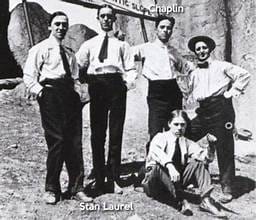
For one of the plays, Charlie dressed as he, himself, believed his character warranted. A few times he stumbled and fell on stage, dragging his cane. The audience roared with laughter. He became a comedic genius. His “Little Tramp”persona became famous and in many ways reflected his own life.

Charlie soon decided to write to Fred Karno in America, to which he sailed.
An excerpt from Charlie Chaplin’s Own Story:

Chaplin gained tremendous favor in America, becoming famous on stage and in film as an actor, writer, director and producer. He also became somewhat of a ladies’ man. Though scandalous, even in those times, he very often was romantically involved with young women, ages 16 through 18, including his wives:
Oona O’Neil, whom he was with until his death;

Paulette Goddard;

Lita Grey;

and Mildred Harris.

Many of Chaplin’s films are satirical, bittersweet or have an air of black comedy. This offered millions of fans comedic refuge during World War I, especially. Bringing humor to dire situations had the affect of decreasing the distress these situations were causing. This can be true of comedy today, as well. And Chaplin’s interpretations of Hitler were considered hilarious. Hitler, himself, derided Chaplin, of course.

In 1957, he was exiled from the United States due to political suspicions. He went to Geneva, Switzerland, where he continued to live with his wife Oona until his death on Christmas Day, 1977, at the age of 88. Charlie had 11 children and was working on music and finishing his autobiography when he passed.
Charlie’s genius and success are easily seen in his following quotes:
“Dozens of ideas pop into my mind as I play; I play my parts each with a fresh enthusiasm, changing them, inventing, devising, accidentally producing unexpected effects, carefully working out others, enjoying every moment of it.”
“Life can be wonderful if you are not afraid of it. — Charlie Chaplin
Coal Town Girls

Coal Town girls was an idea that bubbled up over the years and finally found its way to paper. My mother, Joan, and her best friend, Mary, were often found on our back porch, telling stories of their youth -- the town, the river, the people, the adventures, the sadness's, the joys.
Each month I’ll try to highlight a tidbit from Coal Town Girls!

“A reverent hush comes over the parking lot as the Dean of Students, Miss Will, that elegant looking woman with the short gray hair, steps out of the auditorium.
Gosh, Joan thinks, I want to be just like her. Strong, kind, wise.
Joan enters the building at Miss Will's instruction, the concert band's Pomp and Circumstance vibrating the room.”
Reply